
Why Hire a Landscape Architect When AI Can Design Your Backyard?
AI is quickly integrating into everyday life, including for those in creative industries. But how useful is it when it comes to landscape design?
The short answer is that it can produce something that looks like a garden design. But it’s wise to proceed with caution.
Here’s what to be aware of if you’re considering using AI to design your garden.
It has never seen your site
A landscape architect visits your property. They walk the site, read the levels, observe how the sun moves across the space, note what the neighbours can see, assess the existing vegetation, and build an understanding of what you’re hoping to achieve.
AI works from what you tell it. And if you’re embarking on a landscape upgrade for the first time, you don’t know what you don’t know. You might not think to mention a drainage problem that’s developed, the way the afternoon sun drops behind the neighbour’s extension in winter, or the fact that the slope near the boundary is steeper than it looks. A landscape architect is experienced and proactively identifies these things. AI needs to be told.
The result is a design that responds to a description of a site rather than the site itself.
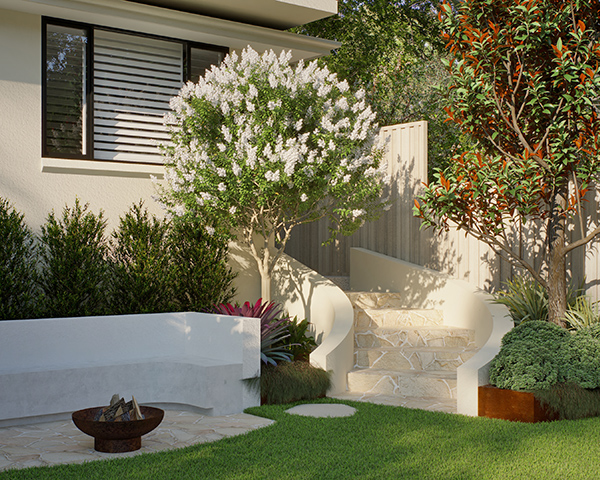
It doesn’t understand how you live
Good design starts with a brief and a genuine understanding of how you’ll get the most out of the space. Considerations like how you like to entertain, what time of day you’re in the garden, who else uses it, and what you want it to feel like come from genuine conversations, not prompts.
AI will give you a response based on what you ask for. But it can’t ask the right questions back, challenge your assumptions, or recognise when what you’ve asked for isn’t actually what you need. A landscape architect will push back when the brief doesn’t serve the site or your goals, and redirect when an idea that sounds good in theory won’t work in practice.
It gives general advice, not specific answers
AI draws on broad, generalised knowledge. It doesn’t know the specific planning controls that apply to your council area, the CDC requirements for your lot size, whether your site is in a bushfire prone area, or what your local conditions mean for plant selection and long-term performance.
A landscape architect works within the specific regulatory and environmental context of your project. They will outline to the correct approval pathway from the start, selecting appropriate plants, materials and furniture that can be sourced.
Most importantly, a landscape architect will make sure the design can be built within the constraints of your site.
General advice is fine for general questions. For a project with real money behind it, you need specific answers.
It doesn’t understand implications from refining a design
If you make the pool 1m wider, a landscape architect understands immediately how that affects the surrounding paving, the relationship to the boundary, the slope, and the connections to the house.
AI doesn’t hold those relationships. It responds to the question asked, without understanding the implications of the answer. It will confidently respond, and even draft a diagram of how it will ‘work’. But the realities of refining a design are overlooked by AI.
It doesn’t understand how everything connects
A garden doesn’t exist in isolation. It sits within a specific set of relationships to the house, neighbouring properties, the street, and to unique site conditions.
Analysing the site and considering how different elements interact provides a cohesive design outcome rather than a collection of independent decisions.
AI can’t read those relationships from a text prompt. A landscape architect reads them from the site.
It’s self-reinforcing and tells you what you want to hear
AI affirms the brief it’s given, rather than challenging it. If you ask for a particular layout, it will produce that layout, even if it’s not the most suitable outcome for the space.
Good design involves pushback from someone who has seen enough projects to know when an idea won’t work. That kind of honest, experienced input is what separates a design that looks good on screen from one that works in reality.
So where does AI actually help?
AI can be used as a supporting role in a landscape project; not the lead.
Early in the process, it can be a useful tool for gathering inspiration, articulating a style direction, or generating ideas to bring to a first briefing. It can help you find the right words for what you’re after, or give you a starting point for a conversation.
It can also be useful later in the process for comparing the fine of construction quotes, like inclusions and assumptions.
The cost of good design
Professional design fees are a fraction of the total cost of a landscape project. For a construction project that includes a pool, paving, planting and lighting, the construction is where the significant money goes. A good design reduces risk and provides savings during the construction phase.
The cost of getting the design wrong isn’t measured in the design fee. It’s measured in variations during construction, features that don’t perform as intended, and spaces that never quite feel right. Good design is hard to quantify, but poor design will leave you with the cost of regret.
If you’re considering a garden upgrade for your Sydney home, the first conversation to have is with a landscape architect. It’s the best investment you can make before the work begins.
If you’re ready to discuss your project, get in Contact below.