
Sydney Landscape Approvals: CDC vs DA for Pools & Gardens
This article is general in nature and is intended as an introductory guide only. Approvals and legislation is subject to change from the time of publishing. The requirements for any individual project will vary depending on the site. Always engage a qualified professional and refer to the relevant authorities and reports for advice specific to your project.
One of the first questions worth answering on any landscape project is whether it needs formal approval; and if so, what kind? In NSW, the answer depends on the scope of the work, the characteristics of your site, and whether your project meets a set of predefined criteria set by the relevant planning authority.
There are three possible pathways: exempt development, complying development (CDC), and a development application (DA). Understanding which applies to your project early can save significant time and money and avoid delays, redesigns, or orders to rectify non-compliant work.
Working out the right pathway is one of the first things a landscape architect will do before the design process begins. Here’s a plain-language guide to how each one works.
Generally speaking, we will verify the feasibility of each option early in the design process and outline the most logical pathway. We recommend proceeding with the pathway that will ultimately deliver the best result for your project; but there are often tweaks that can be made to push the design from one pathway to another without losing the design intent.
Exempt Development: no approval needed
Exempt development covers minor works that don’t require any formal approval, provided the project meets a specific set of standards. If it qualifies, you can proceed straight to construction.
For landscape projects, this pathway is generally available for smaller-scale works. Minor earthworks, small structures, like-for-like replacements, and certain fencing types can all fall under exempt development, under the right circumstances. The key word is “generally.”
Exempt development comes with a detailed set of criteria covering size, height, setbacks, materials, and site-specific constraints, and all of them need to be met for the exemption to apply.
Don’t assume a project is exempt without checking. What appears straightforward on the surface can quickly fall outside the criteria once the specifics of the site are considered.
Complying Development (CDC): fast-track approval
A CDC is a streamlined approval pathway for more substantial projects that meet a specific set of state-wide development standards. It’s assessed and approved by a private certifier, not council, which makes it faster and more predictable than a DA.
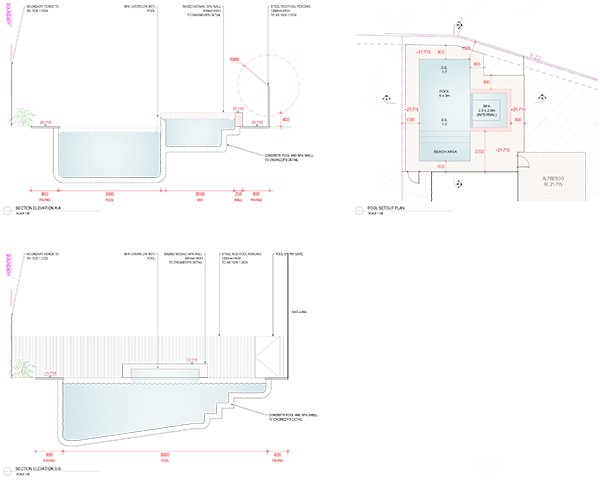
For landscape and residential projects, CDC can commonly apply to new swimming pools, more substantial decks and structures, and earthworks, provided the design meets the relevant criteria for setbacks, siting, height, and other standards.
CDC is often an option for most standard residential pool and landscape projects. But the project, and site, must meet specific criteria relating to the lot. Similar to exempt development, ff the design (or site) does not meet all the criteria, it will need to go through council a as DA instead.
This is exactly why having a landscape architect involved before the design is resolved matters – the drawings need to be prepared to the right standard from the start, not redesigned after the fact.
Development Application (DA): full council approval
A DA is required when a project can’t meet the criteria for exempt or complying development. It involves a more thorough assessment process through council, usually takes longer than a CDC, and requires more detailed documentation. But it’s the right pathway for more complex or constrained projects, and in many cases the only option available.
Common scenarios that push a project into DA territory include heritage-listed properties, bushfire prone land, environmentally sensitive sites, and projects where the design simply can’t satisfy the specific requirements of the CDC pathway.
A DA isn’t something to avoid – it’s just a different process, and one that needs to be planned for in terms of timeline and documentation. The important thing is knowing early whether your project is likely to go this route, so the design and programme account for it.
Why getting the approval pathway right early matters
The approval pathway isn’t just an administrative step, it shapes the design. Setbacks, siting, height limits, and documentation requirements all feed directly into what can be built and how it needs to be drawn up. A design resolved without regard for the approval pathway is a design that may need to be significantly reworked before it can proceed.
This is one of the most valuable things a landscape architect brings to a project. Before the design is developed, the approval pathway is identified, the site constraints are mapped, and the design is resolved within those parameters from the start. The documentation is prepared to the right standard, the certifier or council gets what they need, and the approval process runs smoothly.
If you’re not sure which pathway applies to your project, that’s exactly the kind of question worth raising in an early conversation with a landscape architect. It’s usually one of the first things we can work out together. It sets the whole project up to move forward on the right footing.
If you’re ready to discuss your project, get in Contact below.